URBAN DANDY: CANALSIDE HOUSE – COUNTDOWN TO DEMOLITION
August 2nd 2024
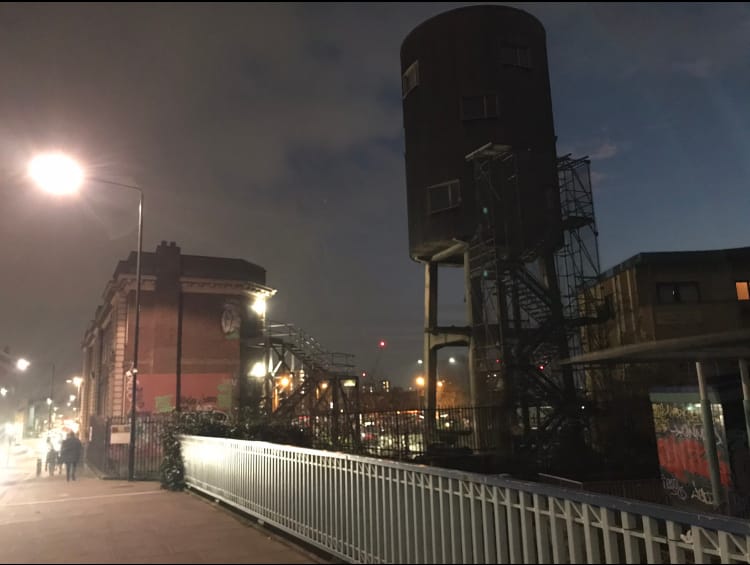
1929: Canalside House opens, serving as the office for Kensal Gas Works.
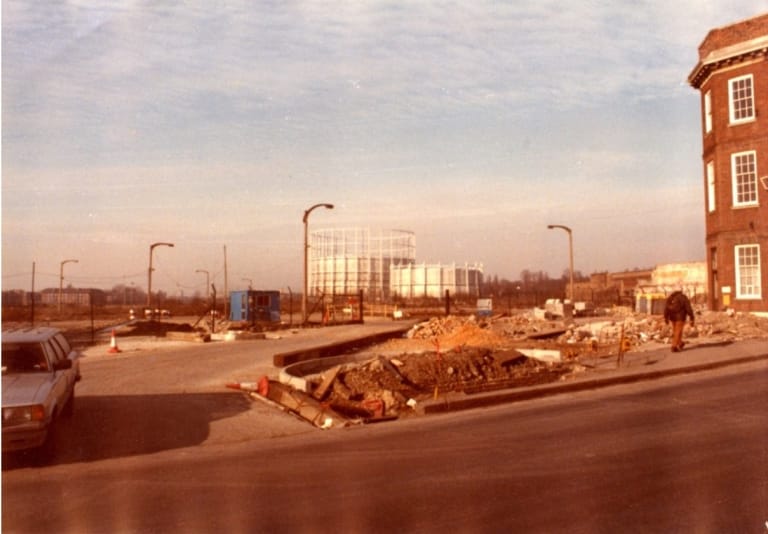
image from rbkclocalstudies
1980s: Used by Kensington & Chelsea Social Council, local charities, and Carnival. Owned by the Kensington & Chelsea Council (RBKC). The building gradually fills up, becoming one of the main centres for North Kensington communities.
2000s: Organisations in the building secure a grant from Tudor Trust to install a lift to improve access for disabled people. The council blocks receipt of the grant. When trying to force through the sale of the building, RBKC will repeatedly invoke the lack of disabled access.
2016: Part of a policy of selling off North Kensington’s community spaces initiated by Councillor Rock Feilding-Mellen, RBKC tells Canalside residents that they will be moved to a converted industrial site on Latimer Road to make way for demolition and the building of private flats. The Latimer Road building is a hot-desking space with no privacy or storage; the council tells the organisations: ‘take it or leave it’.
2017: During and after the Grenfell Tower fire, Canalside House is a hub for humanitarian relief. Under pressure, council Leader Elizabeth Campbell agrees to “pause” the sale.
2018: Without consultation, the council revives its plans to sell, revealed in an executive decision document during a scrutiny committee meeting at the Town Hall. The section on Canalside House can be viewed from 2:01 in this Grenfell Speaks video.
Thanks to community pressure, Deputy Leader of the Council, Kim Taylor-Smith does a U-turn: “Kensington and Chelsea Council has no plans whatsoever to sell off Canalside House, the building is a key base for charities and the voluntary sector, as well as small businesses and other local enterprises, all of which create important job opportunities in the north of our borough”.
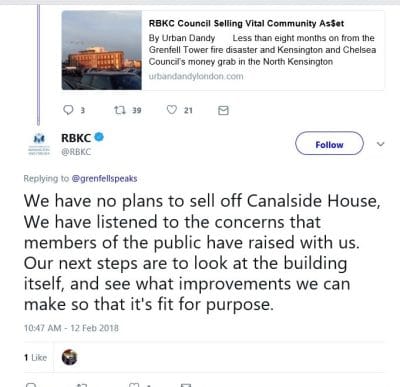
He vows to work with residents to improve the building. This does not happen.
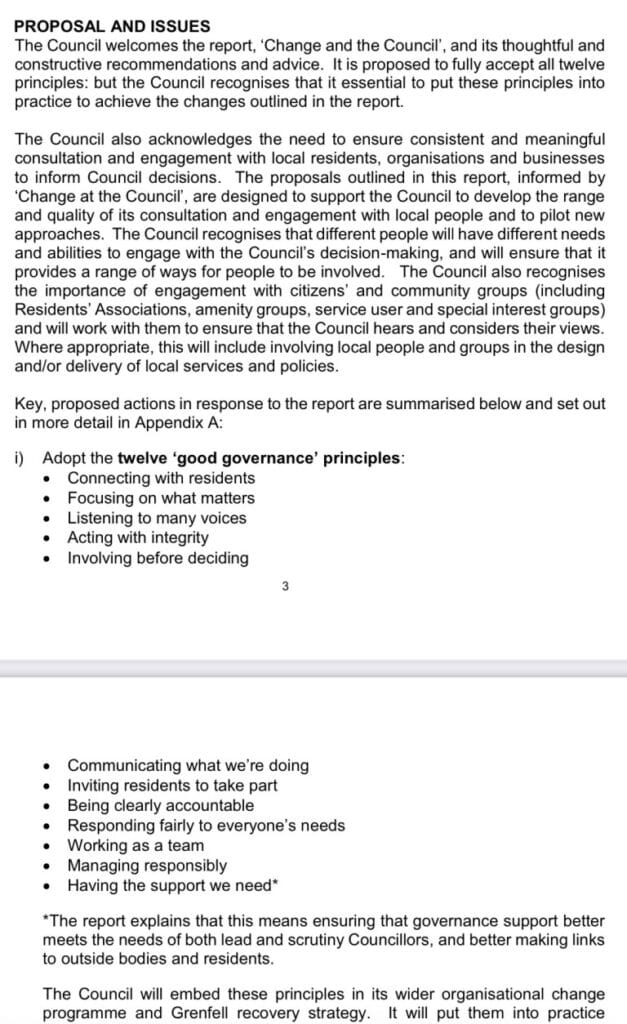
The council publishes its 12 Principles of Good Governance which centre around engagement and consultation with local people ahead of decisions being made: “the council recognises that it (sic) essential to put these principles into practice.” They are to be held to account on this by the Executive and Corporate Services Scrutiny Committee. This does not happen.
September 2018: Cllr Taylor-Smith announces that the sale is back on with the building to be demolished to “maximise the density on the Kensal Gas Works development.”
December 2018: Another U-turn. Council planning officers state that demolition of Canalside House is not necessary for the development on the Kensal Gas Works site. Canalside House is not on the site, but next to it. The council again confirms that the building will continue as a community asset.
With the council’s chaotic handling of the situation, Volunteer Centre (in early 2017) and Portobello Business Centre (in the Covid era) both leave Canalside for more secure premises. The council leaves offices empty and barely promotes the shared working space on the ground floor.
2023: We reveal that the council has done a secret deal to sell to Ballymore. The developer tells us that the council were insistent on including Canalside House as part of the broader Gas Works deal. Canalside is to be the first thing to be demolished and last to be replaced under Ballymore’s plans.
February 2023: Cllr Taylor-Smith denies the deal and says the council will keep residents informed of all developments. There is no further communication to resident organisations from the council in 2023. The building is without heat during Winter 2022/23; it is switched back on after news of the sale is made public.
2024: All tenancies expire. Weeks pass until new one-year tenancies arrive, no other information is forthcoming. Tenants request an urgent meeting. Ballymore agrees, the council does not. The building deteriorates further.
July 2024 – The New Local Plan is approved at a Full Council Meeting at which no adult members of the public can contribute. The meeting is set aside as the annual meeting at which only young people can question councillors.
The Government Inspector’s Report on the New Local Plan states that the “main modifications” the council should make are to adhere to its own 12 Principles policy and to ensure trauma-informed practice, both of which are missing from the Local Plan.
To date in 2024 the only contact made by the council with charities at Canalside House has been to threaten them with losing out when groups are offered spaces at a replacement building if they don’t stay up-to-date with their rent payments. Otherwise, there has been no face-to-face, video or telephone contact between the council and the tenants of Canalside House regarding the future of the building.
By Tom Charles @tomhcharles @urbandandyldn https://urbandandylondon.com/
URBAN DANDY: CANALSIDE – RESIDENTS & COMMUNITY LEFT IN LIMBO
April 4th 2024
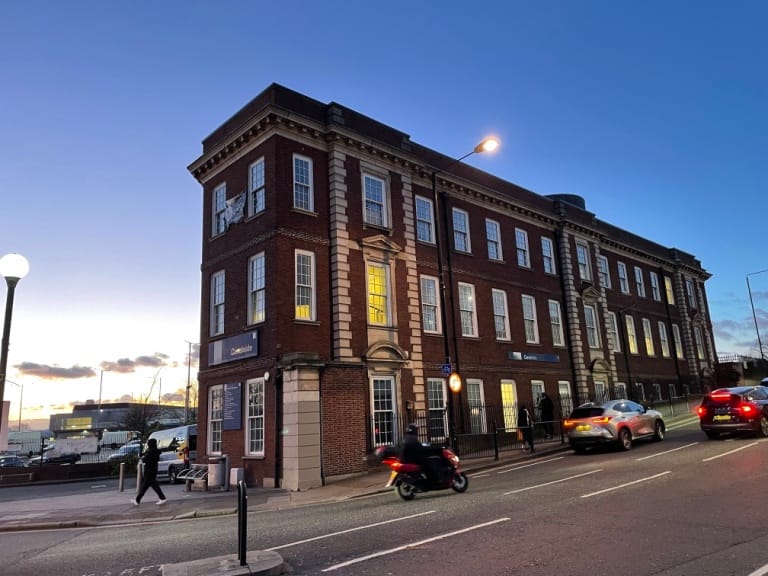
In early 2023 we broke the news that Kensington & Chelsea Council (RBKC) had done a secret deal with the international property developer Ballymore for the sale of one of North Kensington’s last remaining community assets, Canalside House. Ostensibly, very little has changed, but we can update our readers on what hasn’t happened, non-developments that expose the council’s attitude towards its poorer communities, of interest to those who care about North Kensington’s future prospects.
Context
Neglecting Canalside House has been emblematic of the council’s approach to the North Kensington community for decades as successive RBKC leaders have sought to justify the off-loading of the centre by pointing out its poor condition. This mentality persisted despite the Grenfell Tower fire in 2017, after which RBKC spent public money on a review that produced “12 Principles of Good Governance” that the council adopted into its official policies including its Grenfell Recovery Strategy.
Deterioration
Since we last published on Canalside House, there has been no face-to-face, video or telephone contact between RBKC and the tenants of the building. All council communication has been via email and, whether sent by councillors or officers, the emails to residents have all been variations of the same original press release sent to Urban Dandy.
All tenancies – ‘license agreements’ – held by the charities and community organisations operating from Canalside House expired on 31st March 2024. No extensions have been offered and the council has not contacted the groups to provide any information regarding their status in the building. This leaves the groups in limbo, unable to fundraise without secure premises, and unable to plan for an unknown future.
In January, via an appropriate third party, Canalside tenants requested an urgent meeting with the relevant officers from RBKC. Ballymore readily agreed to attend the meeting, but the council dragged out its response, and a quarter of a year has elapsed with no meeting yet set.
Meanwhile, the fabric of building is a major issue. We visited this week and saw holes in ceilings, exposed wires, and heard about the tardiness of Town Hall staff in responding to residents’ reporting of these issues.
Neglect
Canalside House’s landlord, RBKC, has long neglected the building. This has included spurning a grant from Tudor Trust secured by the community to enable a lift to be installed for the benefit of disabled service users; the decision of disgraced former deputy council leader, Rock Feilding-Mellen to evict all the tenant organisations, only averted following the Grenfell Tower fire; and the lies told by his replacement, Kim Taylor-$mith who repeatedly vowed to upgrade the building, but ultimately continued Feilding-Mellen’s strategy of managed decline.
Resident organisations at Canalside House have not had a chance to raise any of the issues caused by RBKC’s non-engagement. Neither the residents nor the wider community were consulted on RBKC’s decision to pursue the sale of their building to Ballymore; and they were not informed that the council’s Local Plan would include a subtle move of a boundary line to enable the Kensal Gas Works housing development to swallow Canalside House.
The rights and protected characteristics of the building’s users under the 2010 Equality Act have been disregarded by RBKC; there has been no democratic oversight of decision-making around the sale, and to date, only one local politician, Emma Dent Coad, has made a significant intervention to call out the council and try to preserve a vital community asset that benefits thousands of local residents.
Read our previous articles about Canalside House here.
By Tom Charles@tomhcharles@urbandandyLDN
URBAN DANDY: CANALSIDE HOUSE – TAYLOR-SMITH’S DECEIT EXPOSED
June 28th 2023

RBKC Deputy Leader Kim Taylor-Smith
With a government inspector now considering Kensington & Chelsea Council (RBKC)’s New Local Plan proposals, more details have emerged showing the extent of the local authority’s deception over the historic community building, Canalside House. Despite the building not being on the site of the huge Kensal-Canalside development, the council has adjusted maps and refused to engage with local groups in a bid to force the sale and demolition of one of North Kensington’s last remaining community assets.
“Do not need to demolish”
Since we revealed in February that RBKC had cut a secret deal with Ballymore for the sale and demolition of Canalside House, resident organisations have received no new information from the council’s Deputy Leader Kim Taylor-Smith who is also Lead Member for Grenfell Housing and Social Investment. In the absence of proactive council leadership, residents have organised meetings with the developer, Ballymore, and analysed RBKC’s New Local Plan to better understand their predicament.
The situation faced by Canalside’s third sector groups has gone full circle back to September 2018 when Cllr Taylor-Smith told them that “part or all of the building will require demolition” to “maximise the density of the Kensal Gas Works development.”
It turned out this was wishful thinking on Taylor-Smith’s part. On 27th November 2018, planning officers from the Kensal-Canalside Opportunity Area Development Team met with Canalside House residents and informed them that the building “does not need to go in order to deliver the site.” The team, who had spent months surveying the site reiterated that developers “do not need to demolish” Canalside House. They expressed frustration that senior councillors had not told the residents about this and had allowed them to suffer months of anxiety knowing all the while that Canalside House was not on the planned development site.
On 3rd December 2018, at the council’s Housing and Property Scrutiny Committee meeting, RBKC planning officers stated that the demolition of the building was unnecessary, and that the development on the Gas Works site could proceed without it.*
No Explanation
Cllr Taylor-Smith then stated that the council had “no plans whatsoever” to sell or demolish the community centre. He promised investment. But throughout 2019, 2020 and 2021, Canalside House enjoyed few improvements. Residents suspected that Taylor-Smith was looking for a way to offload the building, yet the council spent around £600,000 on new windows, so it was also possible that the improvements were just proceeding very slowly.
In October 2022, RBKC published its Local Plan proposals, setting out its intentions for the borough in the coming years, including three major developments: Lots Road, Earls Court and Kensal-Canalside. The Local Plan map shows Canalside House inside the Kensal-Canalside development area, contradicting the information given to local communities by planners, council officers and politicians.
No explanation is given in the Local Plan as to why Canalside House is included or how the decision to include it was reached. The images below from RBKC’s submission to the government
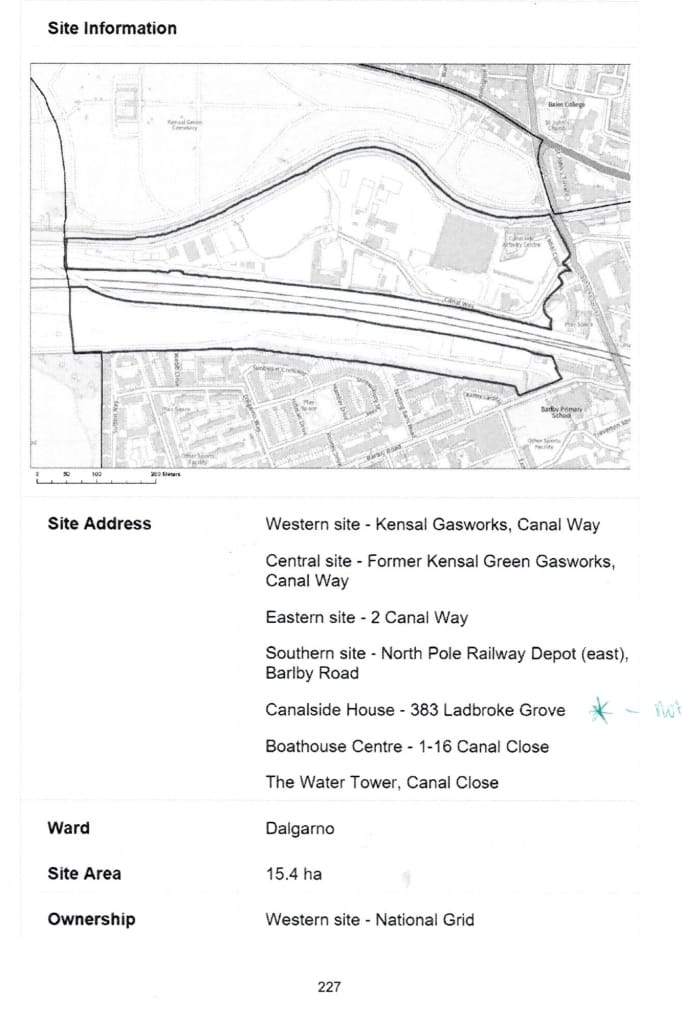
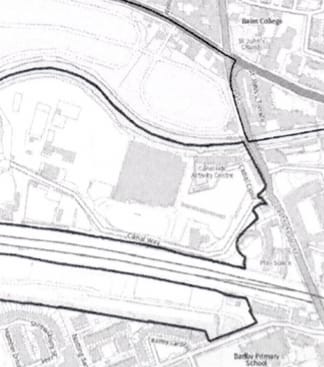
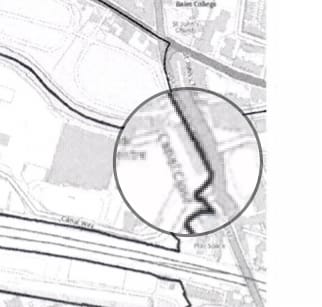
In late 2022, shortly after RBKC’s New Local Plan was published, Canalside House residents were literally frozen out of the building. For the duration of the Winter, they went without heating and hot water. They were switched back on the week after we reported the council’s secret deal withA planning expert we spoke to confirmed that Canalside House is outside the site allocation and was brought into the site at a late stage. This means the planners who drew the maps made a mistake or intentionally sought to deceive the government’s inspectors.
Resident organisations at Canalside House have not had a chance to raise any of these issues. They were not consulted on RBKC’s decision to pursue the sale of their building to Ballymore; they were not informed about the Local Plan and its implications for their ability to operate; their rights and protected characteristics as set out in the 2010 Equality Act were ignored by RBKC; and even if they had felt inspired to read the council’s New Local Plan and looked closely enough at the map to see that a black line had swallowed up their building, they would have found no explanation in the document as to what the council’s decision making process was. In its Local Plan, RBKC fails to identify any potentially negative outcomes for communities in the creation of a new neighbourhood in North Kensington
Government Inspection
At the time of writing, the government inspector is about halfway through her nine days at Kensington Town Hall analysing RBKC’s New Local Plan. She has 173 questions for the local authority.
n the morning session on day one, three RBKC planning department employees represented the council. They were Jonathan Wade, Head of Spatial Development; Preeti Gulati-Tyagi, Planning Policy Team Leader and Chris Turner, Senior Planning Officer. The officers claimed that the council had gone above and beyond its duties in its Statement of Community Involvement. In the case of the Canalside organisations and the hundreds of local people who rely on them, this could not be further from the truth.
We asked Kim Taylor-Smith for a comment on the council’s failure to engage with resident organisations, in accordance with RBKC’s post-Grenfell policies. In reply we received a message from the council’s communications team that provided no new information. Cllr Taylor-Smith has not taken up the suggestion of the resident groups to arrange a meeting with them.
We’ll have more on RBKC’s bid to get the sale of Canalside House past the government inspector soon.
By Tom Charles @tomhcharles
*(At the same meeting, RBKC issued a ‘Lead Member’s Update’ document that made the claim that the council had engaged with the grant maker Tudor Trust to provide a lift inside Canalside House. This came years after Canalside resident organisations had secured £100,000 from Tudor Trust to install a lift in the building to improve access for disabled visitors. The council, under Taylor-Smith’s predecessor Rock Feilding-Mellen, rejected the grant, preferring to keep Canalside House in managed decline. It is not known whether Feilding-Mellen or any of his colleagues considered the inconvenience and discomfort caused to disabled people by their decision. The 2018 claim made by Cllr Mary Weale, that RBKC was working towards installing a lift, was entirely false)
URBAN DANDY: CANALSIDE – BALLYMORE ENGAGING, COUNCIL UNCHANGING
June 5th 2023
International property developer Ballymore has met with community groups from Canalside House to address anxieties over what will come next if the historic building is demolished as part of the transformation of the Kensal Gas Works site. While Ballymore has shown willingness to explore ways to maintain and enhance the vital work done at Canalside House, the building’s owner, Kensington & Chelsea Council, has remained conspicuously silent
Recap
In February, we revealed that Kensington & Chelsea Council (RBKC) had struck a secret deal with Ballymore to sell one of North Kensington’s last remaining community hubs, Canalside House. Decided without democratic oversight, consultation with the affected communities or engagement with tenant organisations, the deal, if completed, will fulfil a long-held wish of the council to rid itself of a centre that was built in 1929. Canalside House has been an integral part of North Kensington, hosting a diverse range of events, charities, community groups and businesses, including being the starting point for Innocent Smoothies, a company now worth over £2 billion but still located directly opposite Canalside House on Ladbroke Grove.
In 2017, following the Grenfell Tower fire, RBKC commissioned a publicly-funded review by the Centre for Governance and Scrutiny that produced policy recommendations that were adopted by the council and formed the basis of what was, in theory, to be a fundamental change of approach. Underpinning it all were the Twelve Principles of good Governance. The council’s leadership were to be held to account on their adherence to their 12 Principles by RBKC’s Executive and Corporate Services Scrutiny Committee.
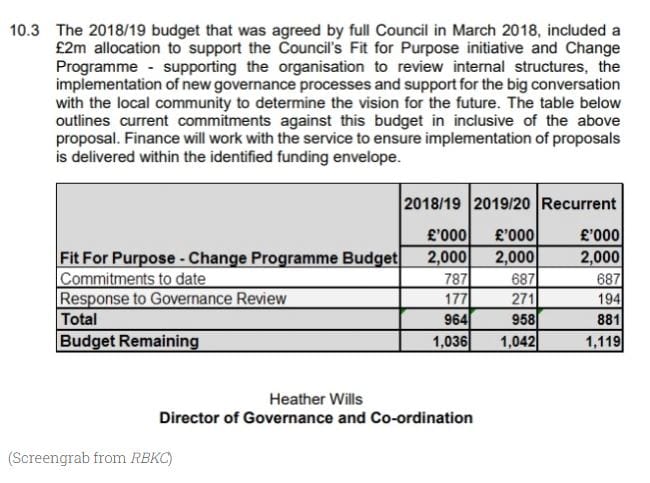
During the same period, RBKC attempted to resurrect the plan of its disgraced former deputy-leader, Rock Feilding-Mellen, to sell Canalside House, but were forced into a U-turn by local residents. While Feilding-Mellen’s replacement, Cllr Kim Taylor-Smith then promised to invest in Canalside House, the building was kept in managed decline culminating in the residents being deprived of heat and hot water throughout last Winter. At the same time as refusing to invest in Canalside House, the council did continue to invest in its ‘Change Programme’ at a cost to the public of £2 million a year, including £271,000 allocated to RBKC’s response to the Centre for Governance and Scrutiny review in 2019-20, and just under £200,000 allocated to it in 2020-21. Over half a million pounds had been spent on the Twelve Principles policy by the end of 2020-21.
RBKC & Canalside House
But the investment in the Twelve Principles has amounted to naught. Here are the principles in full.
1.“Connecting with Residents”
2.“Focusing on What Matters”
3. “Listening to Many Voices”
4.“Acting with Integrity”
5. “Involving Before Deciding”
6.“Communicating What We Are Doing”
7. “Inviting Residents to Take Part”
8.“Being Clearly Accountable”
9. “Responding Fairly to Everyone’s Needs”
10. “Working as a Team”
11. “Managing Responsibly”
12. “Having the support we need”
RBKC has not bothered to engage meaningfully over Canalside House. Council emails to resident organisations have been vaguely worded, containing no offers to meet and feature almost identical wording despite being some being signed by Kim Taylor-Smith and some by Gary Lisney, RBKC’s Head of Property. The same wording was used by the council’s press department when responding to our article on the secret deal.
RBKC has not honoured a single one of its twelve principles in its dealings with the community over Canalside House, a fact that has passed without democratic scrutiny at the Town Hall.
Ballymore
Last week Ballymore met with a delegation from Canalside House. The developer displayed a willingness to listen and to learn about the work undertaken at the building, how it requires a mixed space offering privacy and storage alongside communal space for classes and events.
Ballymore’s plans include provision of a replacement for Canalside House; a four-storey community building that would remain in public ownership under a 999-year lease. Ballymore are keen to create a green space and a place to engage with local residents on the land currently occupied by Canalside House. This means the building is set to be demolished early in the process and Canalside residents face seven years in temporary accommodation, to be allocated by RBKC. Previously, Ballymore had taken the council at its word that the community groups would be appropriately catered for, even stating “RBKC will work with the charities currently based at Canalside House to relocate them to better, more modern accommodation.”
RBKC has not lived up to this expectation. Aside from the council’s disregard for its own ‘Twelve Principles’ policy, RBKC has actively sought to minimise the number of organisations at Canalside House to reduce their own duty of care when the deal with Ballymore is rubber stamped.
RBKC’s silence on Canalside is deafening. The affected communities still don’t reach the status of an afterthought to a council that vowed “change.” We heard that when Ballymore suggested involving the Canalside organisations in discussions in early 2023, the idea was met with scorn from council officials.
As we prepare to mark the sixth anniversary of the atrocity at Grenfell Tower next week, it is noteworthy that a council that vowed that it would learn its lessons and “change” now lags far behind a foreign property developer when it comes to working with and serving the interests of the people of North Kensington.